
 EN
EN
 Srpski
 Русский

Creating
future creators
What makes a school is the people in it. We are parents, engineers and teachers who decided to teach children not to stare at a screen — but to use it as a tool.
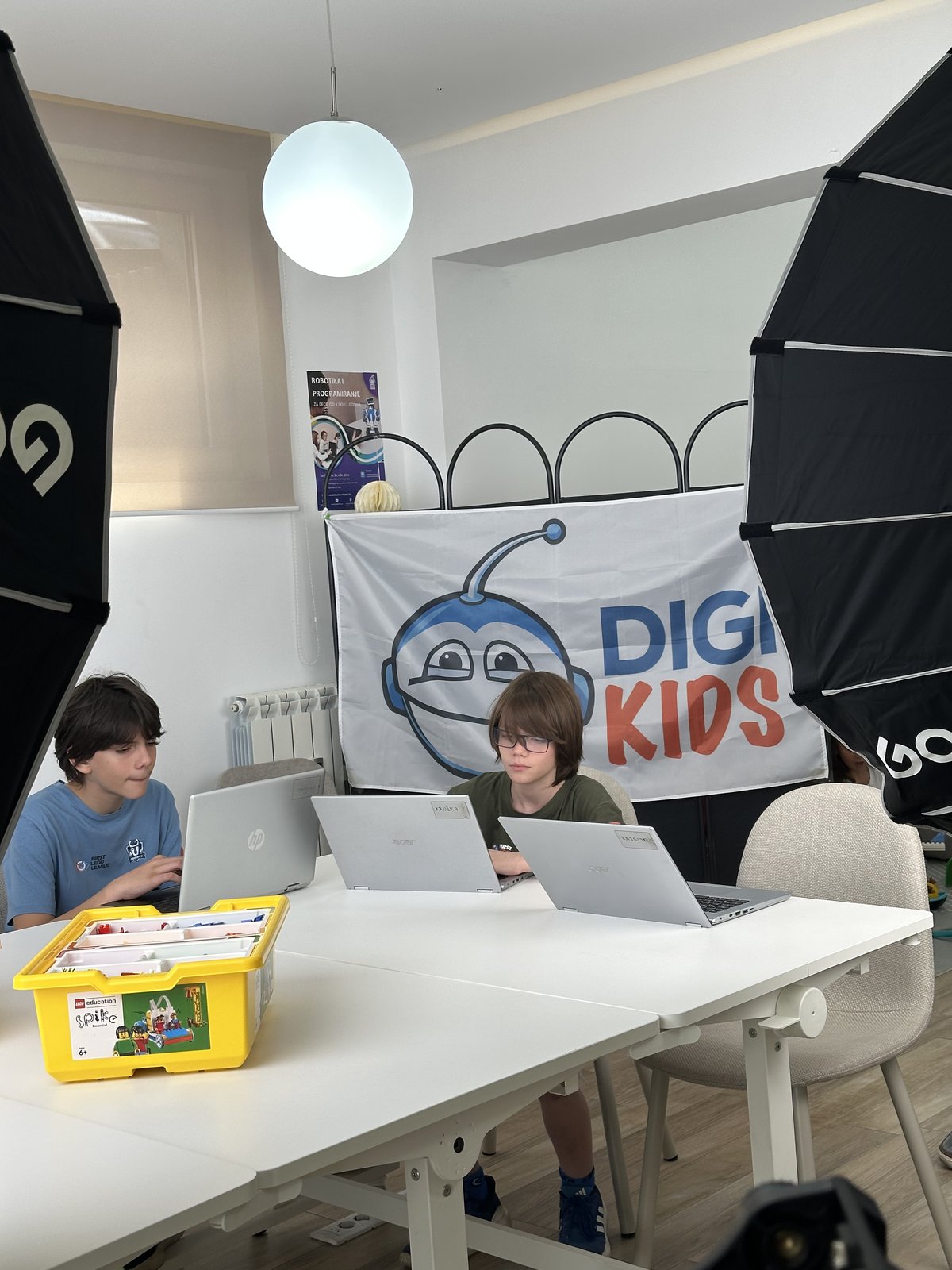
Our classroom in Vračar, Gospodara Vučića 70 — Saturday afternoon, Blue Belt.
Creators, not just users.
We feel that, when it comes to programming, the career angle is overemphasized while a key fact is overlooked: technology can be a powerful tool for expressing ideas, play and creation. For young children this is essential — to learn how to use technology as creators, to understand both its benefits and its risks.
This approach is known internationally as creative computing and is a growing educational trend. We've been applying it since 2019 — and since 2024, in Vračar as well.
We're focused on all kids — not only on gifted mathematicians. We're especially proud of the high number of girls in our groups. We believe in the potential children have at an early age, which is why our school originally addresses ages 3.5 to 13.
Why isn't 3.5 too early?
Our approach combines Montessori pedagogy (respecting a child's potential at an early age) with creative computing (technology as a tool of expression). With the youngest we do tactile programming — children physically manipulate objects and sequences (Lego, Tale-Bot, Coding Express), without screens. They develop logical thinking, fine motor skills and concentration — with minimal screen time.
What we believe.
Every child is born creative
Our job isn't to make children creative — our job is to not kill the creativity they already have.
Less is more
Maximum 6 kids per group. 60 minutes a week. No homework. Whatever we make in class, we make in class.
Mistakes are part of learning
We don't grade kids. We assess whether they learned and whether they had fun. If both are "yes" — the class was a success.
Less screen, more hands
The youngest work without screens — with real Lego bricks and physical robots. The screen as a tool, not as entertainment.
Honest conversation
After the trial class we'll honestly tell you whether we think the program is right for your child. We don't sign kids up at all costs.
Continuity
A child who starts in Legići can stay with us until 13. Same teachers, gradual progress, a visible journey.
Projects · Passion · Peers · Play.
Our approach rests on the concept of 4P — four pillars of creative learning developed by researchers at MIT's Lifelong Kindergarten program. We believe that for children to grow into the thinkers and innovators of the future, they should learn through projects that genuinely interest them, with peers, through play.
Projects, not tasks.
If someone writes a program that sorts a list of numbers — that's a task. If they code a birthday card — that's a project. Projects don't have right or wrong answers — they are the result of iteration, testing and refining ideas. They are more educational, more fun, and children stick with them.
The child's interests.
When a child works on something that interests them, they're ready to invest more effort and learn more persistently. Fun doesn't mean easy — even children understand the value of effort if it leads toward a goal they chose themselves. Our program lets children link learning to their own interests.
Peers as amplifiers.
Collaboration and sharing ideas spark creativity. With us, "copying" is allowed — and even encouraged — as long as it's understood, built upon, and the original author is credited. A group doesn't just increase the number of ideas, it creates an environment where learning is a natural, social experience.
Play that tests limits.
Learning through play is the core method at the ages we work with. But not any kind of play — play that involves curiosity, risk and exploration: "What if we speed up the robot? What if we fly the drone higher?" Through this kind of play, children develop an investigative spirit and a sense of control over technology.
Although we avoid focusing on competitions, we use challenges that require collaboration and coordination — those moments are the richest in learning.
Lego Education 5E — what a class looks like.
5E is a scientifically validated framework developed by Lego Education. We follow it strictly, phase by phase.
Engage
The teacher starts with a story, a game or a question the children can explore: "How do you think a little robot could cross a bridge?" The goal is to spark inner curiosity. If a child asks "but why?", we've won.
Explore
The kids take the lead. They build, program, try things out. The teacher sits back, watches, helps only when asked. Mistakes aren't corrected — they're explored. "Hmm, what got tangled up there? Try a different way."
Explain
We pause. We talk. What did you make? How does it work? What would you fix? Now the teacher becomes a teacher — introducing "proper" words (algorithm, loop, variable) only after the child has already discovered the concept in their own words.
Extend
A new challenge, a little harder. Differentiated approach — a child for whom it's easy gets an extra task, a child struggling gets a helping hand. Nobody is bored, nobody is scared.
Evaluate — Share and assess
The kids show each other what they made. We applaud. We ask: "What worked best for you?" We don't grade the children — we grade ourselves. Did these kids learn? Did they enjoy it? If yes — the class was a success. If not — next time we do it differently.
The people teaching your children.
Our team are parents who teach as if they were teaching their own children — because they do. Parents, or young but experienced teachers.
Bojana
Co-founder · Teacher · Program coordinator
Pedagogue by profession, mom of three. Specialized in working with the youngest — Legići and Yellow Belt are her territory.
Predrag
Co-founder · Lego enthusiast
Software engineer, Lego master. Leads the middle belts — Blue, Purple, Red. Builds all the robots the kids later copy.
Dušan
Co-founder · FON, software engineering
Lecturer at the Faculty of Organizational Sciences. With us, he runs the hardest groups — Black Belt, AI, Python.
And six teachers who run the regular belts — programmers, pedagogues, or parents who completed the coding path themselves. You'll find out who teaches your group at the trial class.
Five years, step by step.
Three families, seven children, one conversation
A parental worry: how do we make sure our children grow up with technology in a healthy way. Engineers, a pedagogue, an actress — different angles, the same decision.
Fifteen students, two belts
Opening of the first classroom on Voždovac. We tried the Lego Education 5E methodology — it worked. Parents started recommending us to the neighbors.
A system that guides a child from 3.5 to 13
We built the full pathway — Legići, Juniors, Belts, Black Belt. A child who starts at age 4 can stay with us until 13.
We opened a location at Gospodara Vučića 70
1050+ students later, we opened the Vračar location — same team of teachers, same approach, same minimal groups of six children.
Six things parents remember us by.
Google rating
Most from parents who continued into a second semester. Click to see all reviews.
Students so far
Totaled across the DigiKlinci network since 2019. The Vračar location is our newest — with the same methods.
Max kids per group
Beyond this limit a teacher can't give every child attention. We often have groups of just 4 kids.
Years of experience
The difference between our first generation and today's season shows in every class — tested, refined, repeated.
Teachers on the team
Every age has its own. A pedagogue runs the preschoolers, a software engineer runs Black Belt. The right people for the right level.
Homework
Whatever we make in class, we make in class. Parents don't have to help at home — that's by design.
Five years, many children, one approach.
The numbers include students from the DigiKlinci network since 2019 — DigiKids Vračar is our Vračar location.
The fastest way to meet us?
A trial class. 45 minutes. You see how we teach. Your child sees how it feels. We see whether we can help. No commitment, no cost, no sales pitch.